The 2004 Georgia Navigator Cup will on July
3-4 at Smithgall Woods/Dukes Creek, in conjunction with the
USOF Convention. Follow this
link for details.
Georgia Navigator Cup 2003
By Laurie Searle
Throughout the MLK weekend,
hundreds of orienteers passed by the colorful t-shirt quilt
near the registration desk. Many paused to touch one of the 10
quilted blocks, recalling their past GA Navigator Cup (GNC)
experience. Others boasted of their own GNC t-shirt
collection, which sounded as impressive as their tall tales.
Still more looked forward to their first A-Meet and I proudly
thought, "They've come to the right place."
The 2003 Georgia Navigator Cup
is the 11th consecutive A-Meet hosted by the Georgia
Orienteering Club. This year's event featured the GA Navigator
Cup, U.S. Interscholastic Orienteering Championship, SE
Trail-O Championship, Extreme-O, and more at Sweetwater Creek
State Park in Lithia Springs, GA, Jan 18-20.
A Tribute to GAOC
Volunteers
Hosting the Interscholastic
Champs presented a special challenge due to its soaring
popularity over the last few years. Early on we considered
paying volunteers in order to attract enough to support the
anticipated 600 competitors, but so many
"old-timers" wouldn't consider taking money, we
developed an incentive program instead.
Each volunteer received the
following freebies in exchange for working at least two days:
event registration, t-shirt, local meet coupon, raffle ticket
(for the annual raffle), Saturday night dinner, and
commemorative pin.
We also augmented our normal
volunteer staff with volunteers from other groups. All total we had over 70
volunteers! These dedicated folks really stepped up to the
challenge and GAOC was glad to show its appreciation.
Day 1 - Steep and
Challenging
Saturday's competitors woke to
14 degree temperatures and clear skies but by the time they
arrived at the Start, temperatures were just right for
climbing the steep hills on the east side of the park.
Sam Smith was the course
setter and official observer this year. He set longer courses
on Day 1 that challenged competitors to choose between direct
route options with lots of climb or faster route options that
required navigational expertise to contour around the hills.
Sam stationed himself at the top of a hill to observe
orienteers and was a bit surprised at what he saw.
"A lot of upper-level
competitors did unnecessary climb, running up and over the
hill instead of contouring around," he observed.
"And the yellow course competitors seemed less skilled
(that he anticipated). Many turned left instead of right for
their control, as if they were holding their map
"straight up" like a driving map instead of
orienting the map in the direction of travel."
Once competitors finished
their A-Meet courses, they were treated to one of Bill
Farrell's famous Trail-O courses set on the shore of Sparks
Reservoir. Bill set about a dozen control clusters for this
year's competition and Pete Curtis took first place,
while Walter Siegenthaler took home the SE Champs coveted orange
T-shirt.
Day 2 - Shorter and More
Technical
Sunday's competition took
competitors to the west side of the park, which offered
shorter but more technical courses. On lower-level courses,
competitors could choose between longer trail routes or
shorter more direct options, which required more navigational
skills. On upper-level courses, competitors had at least one
long leg that could make or break their finish times. Overall,
times were fast and results were calculated in record time for
the 2pm Results Ceremony.
Day 3 - Extreme Fun
Over 70 competitors stayed
over on Monday for the now famous Extreme-O, hosted by Mal
Harding and Chuck & Linda Ferguson. This year's
competitors were treated to an extraordinary
"cootie factor" as they crawled through muddy
culverts and dank caves, climbed a cargo net up a steep
embankment, navigated a string-o through a swamp, inched
across a rope bridge over a creek, and waded through
waist-deep mud past a plastic alligator.
Making Memories
All throughout the weekend,
professional photographer Eric Beach was on hand snapping
photos of competitors and volunteers in action. He captured
over 600 snap shots, which are available for sale on the GAOC
website at www.gaorienteering.org.
As for myself, I have another
t-shirt to add to the quilt and more great memories of another
wonderful Georgia Navigator Cup.
What's Up for Next Year?
GAOC invites you to attend our
2004 GA Navigator Cup on July 3-4 in Cleveland, GA, as part of
the USOF Convention week June 26-July 4, 2004, hosted by the
Carolina Orienteering Klub and the Georgia Orienteering
Club.

Notes from a Meet Director HAM
by Laurie Searle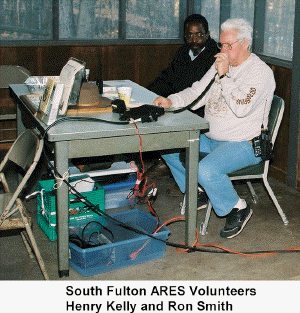
Back in 2001, my husband Sam Smith
encouraged me to get an amateur radio license. At first I
thought I'd have problems passing the test, but the FCC makes
it easy by publishing the answers to the multiple choice test
and not requiring Morse Code for the Technician's license.
What's this got to do with orienteering?
Well up until that point, GAOC mostly used cheap
walkie-talkies to communicate between the Start, Finish, HQ,
and Field at its A-Meets. But since walkie-talkies are only
good for short ranges they weren't very effective.
Once I got my license and joined the ranks
of amateur radio operators who call themselves hams, Sam and I
could communicate at further distances during our A-Meets. Our
network grew when we discovered a few other hams in our club,
so we started using ham radio to aid our search & rescue
efforts. Our plan went something like this: three hams drove
the perimeter of the park, while two hams search in the woods.
As overtime competitors were found, the ham would communicate
to the others and the finish line.
This year, GAOC improved its communication
plan 10 fold. Steve & Robin Shannonhouse, Bill Farrell,
and Martha Carr all got amateur radio licenses and we engaged
the South Fulton Amateur Radio Emergency Service volunteers to
run a Net Control at our Meet Headquarters. All radio
communication passed through the Net Control operator who
either relayed the message to the appropriate station -- such
as Start calling Meet Director -- or recorded the message for
later transmission if the station was busy.
I can't tell you what an improvement this
made in our overall meet administration. Our crew chiefs got
an immediate answer to their questions, rather than having to
send a valuable volunteer to search for the meet director; we
could position observers in the woods who recorded competitors
as they passed by so we knew exactly where to look for folks;
and we could move volunteers around as one station got less
busy and another picked up.
I highly recommend the use of amateur radio
operators for your next orienteering A-Meet. And if you can't
find a local amateur radio club to help you out, why not
become a ham yourself? It's easy, lots of fun, and will
greatly improve your meet administration.
For information on amateur radio, go to the
American Radio Relay League website at: www.arrl.org.


